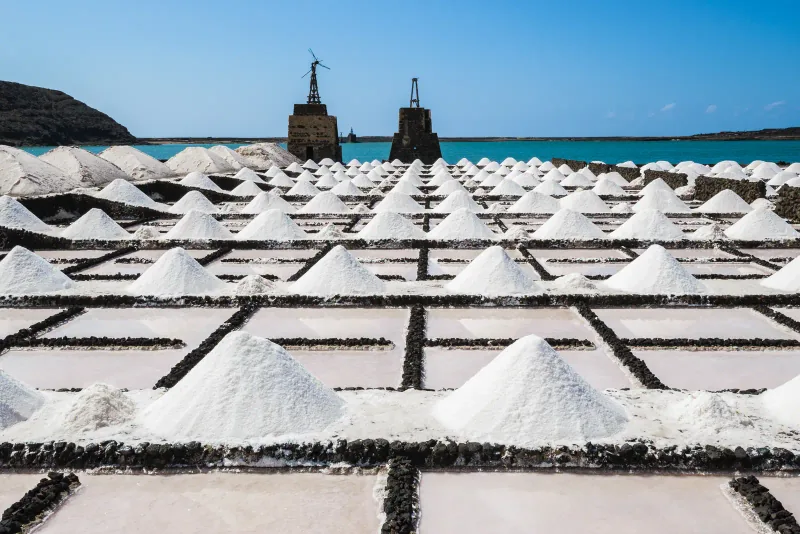
Janubio Salt Flats
Lanzarote
On the southwest coast of Lanzarote, nestled between an ancient volcanic crater and the Atlantic, the Salinas de Janubio offer one of the most photogenic and lesser-known landscapes of the island. Covering more than 440,000 square meters, they are the largest salt flats in the entire Canary archipelago—a geometric checkerboard of evaporation ponds that change color depending on the time of day, season, and salt concentration.
A Mosaic of Impossible Colors
What makes the Salinas de Janubio unique is their color palette. The ponds shift from deep blue to dazzling white, from pale pink to deep purple, and from ochre to green depending on the mineral concentration and the presence of halophilic microorganisms. Viewed from the roadside viewpoint, the image resembles an abstract painting crafted equally by nature and human hands.

Three Centuries of Salt-Making Tradition
The salt flats were constructed in 1895, taking advantage of a natural lagoon formed by lava from 18th-century eruptions. For decades, they were the economic engine of the area, producing up to 10,000 tons of salt annually for fish preservation. Today, production is lower—about 2,000 tons annually—but Janubio salt has become a gourmet product appreciated by the island's chefs.
The viewpoint next to the LZ-703 road is free and offers the best panoramic view. Janubio's artisanal salt can be purchased in gourmet shops in Lanzarote (from €3). Combine the visit with Los Hervideros and El Golfo, which are less than 5 minutes away by car.
The Salinas de Janubio are proof that in Lanzarote, even industry becomes landscape: a canvas of colors that changes with every hour and every season, where human hands and volcanic force work in silent harmony.
LIVVO Tip: A good stop on a road trip through the south.
More to see in Lanzarote
Timanfaya National Park

Timanfaya National Park
Over 50 km² of volcanic landscape shaped by the 1730–1736 eruptions. The Ruta de Los Volcanes winds through a sea of solidified lava with smoking craters where underground temperatures exceed 600°C. The geothermal demonstrations at Islote de Hilario are a must.
Papagayo Beaches

Papagayo Beaches
A cluster of pristine golden-sand coves with crystal-clear water in the south of the island, protected within the Monumento Natural de Los Ajaches. Playa Mujeres, Playa de la Cera and Playa de Papagayo are the best known. Calm waters ideal for snorkelling.
Jameos del Agua

Jameos del Agua
A unique space created by César Manrique inside a volcanic tunnel, where art and nature merge in a breathtaking setting. Highlights include its interior lake, the natural auditorium and the blind crab, an endemic species.
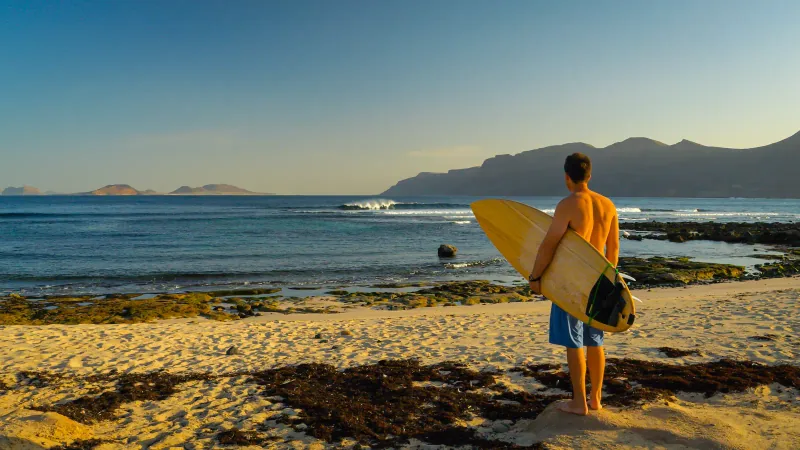
Surfing in Famara
Surfing in Famara
With over 6 km of sand and consistent waves for much of the year, suitable for both beginners and advanced surfers. The dramatic backdrop of the Risco de Famara and the laid-back village nearby make it one of the most authentic spots on the island.